
The best APS-C compact cameras are some of the most popular cameras around right now. Bolstered by the tremendous hype and success of the Fujifilm X100VI and Ricoh GR IV series, the APS-C compact provides a pitch-perfect blend of performance and practicality for street-shooting and travel, blowing even high-end smartphones out of the water thanks to their large APS-C-sized sensors..
In compact terms, only a full-frame compact camera is going to do better, and those are relatively rare and expensive. Most APS-C compacts prize agility and portability, using a fixed prime lens rather than a zoom, in a naturalistic wide or standard focal length. They tend to be power-hungry, and only have space for a compact battery, so spare batteries or power banks are a good idea for a day's shooting on the street.
However, there is one big advantage that all the APS-C compacts on this list have in their favor, and the reason why I'm so personally fond of them. They're just so much fun to use. The Fujifilm X100VI and its predecessors have been referred to as the cameras that made people fall in love with photography again, and the Ricoh GR cameras also have a devoted following.
Here are my picks of the best of the best – but do see also our general guide to the best compacts for a broader selection.

Gareth is the Reviews Editor at Digital Camera World and the person in charge of approving all the latest camera-related tech. A fan of compact cameras with big sensors, you won't find him without his trusty Fujifilm X100VI.
The Quick List

The much-awaited update to the best-selling X100V adds a higher-resolution 40-megapixel sensor. This camera has a retro charm that is almost impossible to resist.

The Ricoh GR IV made several key upgrades to the GR III, improving battery life and stabilization. Its wide 28mm perspective gives you a broader view of a scene than the X100VI.

The GR range is a classic camera range, loved by street photographers. There are several models on sale today, as well as some special editions. The GRIIIx has a slightly less wide-angle lens, making it more suitable for portraits.

This edition of the GR IV offers an HDF highlight diffusion filter that gives a filmic look to your photos. The camera is otherwise the same as the OG Ricoh GR IV, it simply trades the built-in ND filter for a diffusion filter.

Taking out the color filter doesn't just create lovely black-and-white images – it also means less noise. Colorless cameras aren't for everyone, but the GR IV Monochrome is an excellent choice for documentary-style arty shots.

Designed with street photography in mind, this stylish version of the Ricoh GR IIIx features a textured grip and a metallic blue ring surrounding the lens. Otherwise, it's the same deal – the difference is all in the styling.
The best APS-C compact cameras: the full guide
Why you can trust Digital Camera World Our expert reviewers spend hours testing and comparing products and services so you can choose the best for you. Find out how we test.
Best compact APS-C camera overall
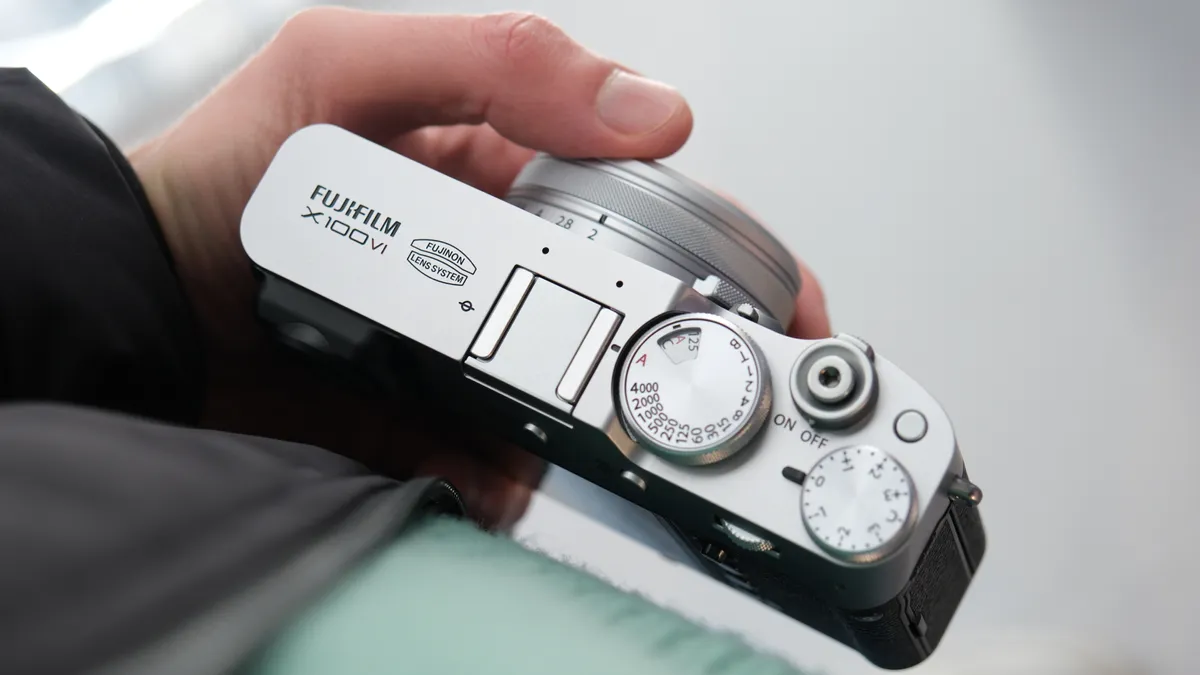
The X100VI is the sixth version of Fujfilm's beloved APS-C fixed lens compact camera. It now uses Fujifilm’s latest 40-megapixel X-Trans processor, and also adds built-in image stabilization to the the bestselling X100V, to give up to six stops of compensation for camera shake.
This retro-styled compact features 23mm f/2 lens with a 117-area hybrid phase/contrast autofocus system is faster than before. But the charm of this camera remains its analog dials for key exposure settings – coupled with its hybrid viewfinder. Switching between its high-resolution electronic viewfinder to a rangefinder-style optical viewing system is a key feature that makes this camera such a favorite for street photography.
While the X100VI has been available for a while, its enduring popularity does mean that its price has held since launch, and it can be pretty hard to get hold of. If you see one in stock and you think you might want it, don't wait – pounce!


Read more: Fujifilm X100VI review
Best APS-C compact with a 28mm equivalent lens

The latest in the X100-rivaling Ricoh GR series, the Ricoh GR IV is an update that doesn't change the fundamentals, but quietly adds a raft of improvements that make it a much better buy than the now-discontinued GR III. Fundamentally, you're still working with an APS-C sensor and a 28mm equivalent lens, but the GR IV has crammed its tech into an even slimmer body, making it one of the most pocketable and portable APS-C compacts around.
The battery life has also been upgraded from previous versions (as this has been a common complaint regarding GR cameras), and it is now CIPA rated to 250 shots rather than 200, which still isn't a lot, but since CIPA ratings are quite conservative in practice you'll get more than that. The GR IV also newly boasts 5-axis image stabilization, making it easier to get sharp shots hand-held at slower shutter speeds, and thanks to its new processor, it produces cleaner results at higher ISOs. This adds up to making it an excellent choice for low light.
While the GR IV has some limitations, like the fiddly microSD and limited video features, it's one of the biggest upgrades yet for the series.


Read more about the Ricoh GR IV
Best APS-C compact with a 40mm equivalent lens

This latest GR IIIx has the same design as the original GR III, but swaps that camera’s wide 28mm equivalent lens for a more natural 40mm angle of view. The GR IIIx offers a more normal, natural perspective, close to a ‘standard’ lens.
The 26.1mm f/2.8 GR lens incorporates two aspherical lens elements and a 2-stop ND filter, which can be engaged for very bright conditions. Inside is a 9-bladed diaphragm for smooth bokeh, and this lens can focus down to 0.12m for close-up shots.
The GR IIIx does share some limitations of the GR series. There is no viewfinder, which we guess is the price of the super-compact design – though the rear touchscreen display does have an Outdoor View setting for bright light. The GR IIIx is also restricted to Full HD movies only. That’s probably no great drawback in a camera designed for shoot-from-the-hip street photography, but it does draw attention to the older tech used in this camera.
Note that, while the GR III has been replaced with the GR IV, the longer lens GR IIIx is still the current model, as of April 2026.


Read more: Ricoh GR IIIx review
Best compact APS-C camera for a film look

If I want to make my digital photos look more like film, the first thing that I do is add a diffusion filter to the lens. The Ricoh GR IV HDF has one built in, which can be turned on and off with the click of a button. That gives light sources a lovely glow and creates an overall slight softening effect.
This filter is activated with a custom button on the back of the camera, giving a soft glow to highlights in your photos, for a more ‘analog’ look. To make room for this new feature, you do lose the original 2-stop neutral filter on the regular non-HDF versions.
There are two HDF models – the Ricoh GR IIIx HDF offers a 40mm lens, whilst the newer GR IV HDF has the original 28mm f/2.8.


Read more: Ricoh GR III HDF review • Ricoh GR IV HDF review
Best black-and-white APS-C compact camera

If you're annoyed by noisy images but love black-and-white shots, take a serious look at the Ricoh GR IV Monochrome. This camera looks and acts just like the original GR IV, except that there's no color filter. That means the GR IV Monochrome only takes black-and-white shots.
There's a reason to skip out on the color filter instead of just using a monochrome color profile or converting images later while editing. The GR IV Monochrome had noticeably lower noise, both at base ISO and high ISOs. There's also a lot of dynamic range to play with on the DNG files in post.
Will you notice in, say, a reduced-resolution Instagram post? Maybe not, but the GR IV Monochrome is an excellent tool for photographers who love black-and-white photos. The built-in red filter also adds a punch of contrast at the touch of a button.


Read the full Ricoh GR IV Monochrome review
Best compact APS-C for looking good on the street

As mentioned, there have been no shortage of special editions of Ricoh GR cameras, including the Ricoh GR III Street Edition with its yellow ring around the lens, and the metallic gray Ricoh GR IIIx Diary Edition. However, my current favorite is the sleek-looking Ricoh GR IIIx Urban Edition. The most distinctive difference is that this time it has a blue lens ring, which according to Ricoh is designed to evoke 'the impression of an azure sky reflected in a puddle after a rain, or neon lights of a city that never sleeps.' However, look closer and you'll also see that the metallic body has a textured surface for a grippier hold.
The GR IIIx Urban Edition came with a few new features (which have since found there way back to the original GR IIIx via firmware). These include 'Snap Distance Priority Mode', which allows you to set your subject distance and depth of field in advance, and an 'Auto-area AF Center' mode, which keeps the camera hunting in the centre of the frame for the focal point.
Ultimately, there isn't a real difference between this camera and the GR IIIx – however, I do think it looks quite a bit more stylish. If that's a priority for you, then the Urban Edition is the one to buy.
How to choose the best APS-C compact camera
If you're choosing an APS-C compact camera, you've already narrowed things down quite a bit. You know which type of camera you're buying, and you know the sensor size you want. So, the main thing to decide is what focal length of lens you're looking for.
As you can see above, APS-C compacts currently come in three lens options: 28mm, 35mm or 40mm equivalent. None of these is empirically better than another – it's down to your personal preference. The wider field of view from a 28mm lens allows you to fit in more of a scene, but requires you to get closer to your subject if you want them to fill the frame. Whereas a narrower 40mm perspective provides a tighter field of view that's better for picking out details, but can mean you're unable to fit everything you want to capture into the frame. A 35mm lens, meanwhile, sits between the two.
Availability is also a factor – the Fujifilm X100VI is hugely popular, and sells out quickly, so you will likely have to either be patient or opt for another camera. The X100VI is one of the most expensive of the bunch (for the color cameras anyways), but by far the most fully featured – it offers a hybrid viewfinder, 4K video, subject-detection focus, fast burst shooting, and a high-resolution 40MP sensor. The cheaper Ricoh GR cameras, meanwhile, do not.
How we test cameras
During our testing process, we take compact cameras out into the real world, snapping photos in various lighting situations to gauge their performance. With a collective experience encompassing hundreds of models, our reviewers compare the results against both current competitors and past iterations.
Our focus lies heavily on image quality, scrutinizing the details captured in each shot. Since compact cameras prioritize ease of use and portability, we also closely examine the ergonomics and handling of every model we evaluate.
Find out more about how we test products at Digital Camera World

